
Announcing our next-gen Mapping Tool (MT2): The Blueprint for Clean Clinical Data
In an increasingly connected global healthcare landscape, the phrase “the standard language of health” has transitioned from an ambitious vision to an operational necessity. As clinical data explodes across electronic health records (EHRs), lab systems, and global repositories, the pressure to cleanly map local data to international standards has never been higher.
At West Coast Informatics (WCI), we have spent years engineering tools to reduce the complexity of this healthcare data puzzle.
The latest example is the WCI Mapping Tool 2.0 (MT2), our next-generation, enterprise-grade terminology mapping platform built to streamline data harmonization. This blog provides an overview of MT2's key capabilities, with a link to a full demonstration walkthrough at the end. To learn more, visit our Mapping Product Page.
Key Mapping Capabilities
MT2 provides the practical capabilities teams need to create, review, maintain, and publish high-quality mappings across a wide range of healthcare use cases.
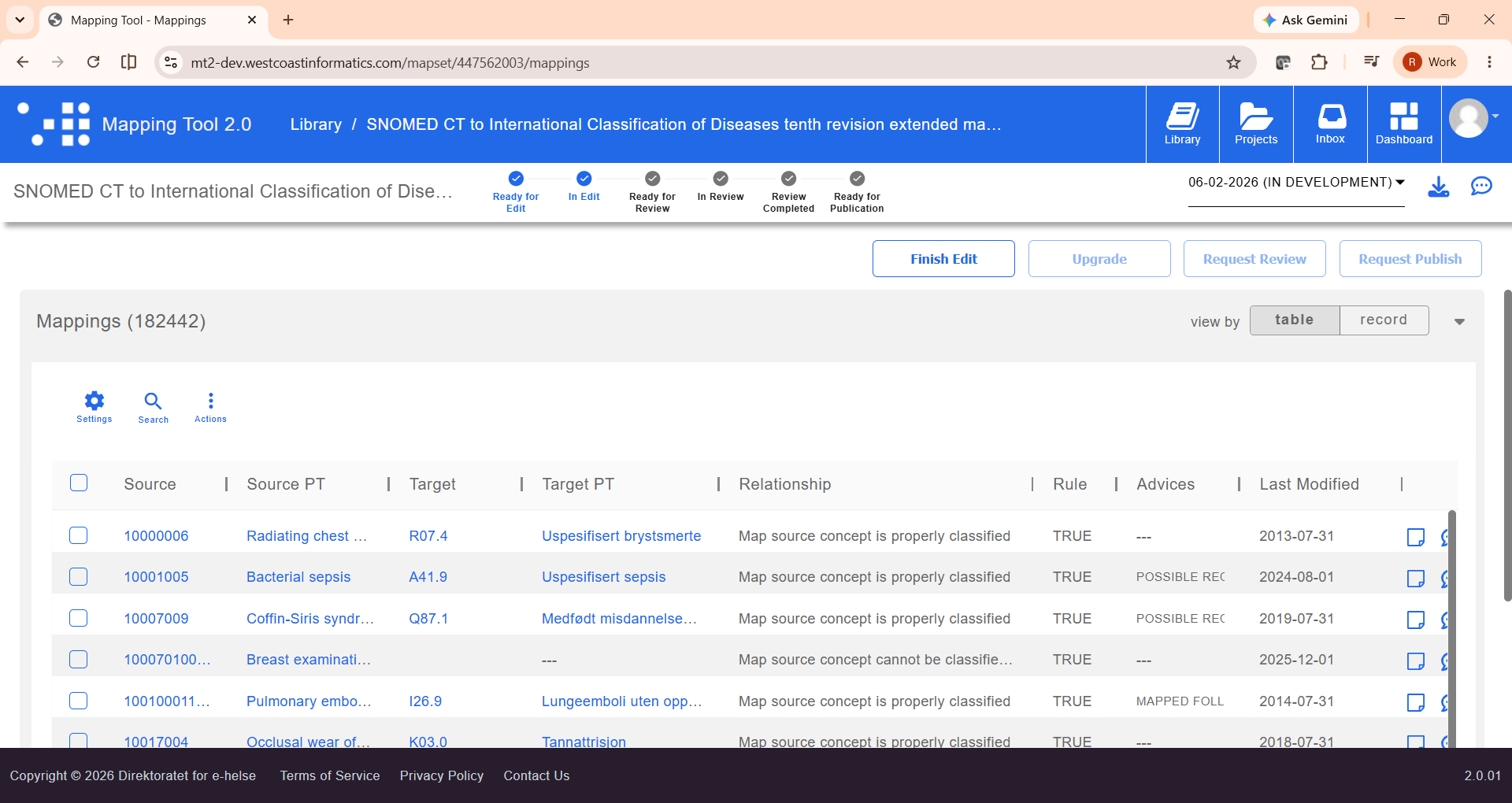
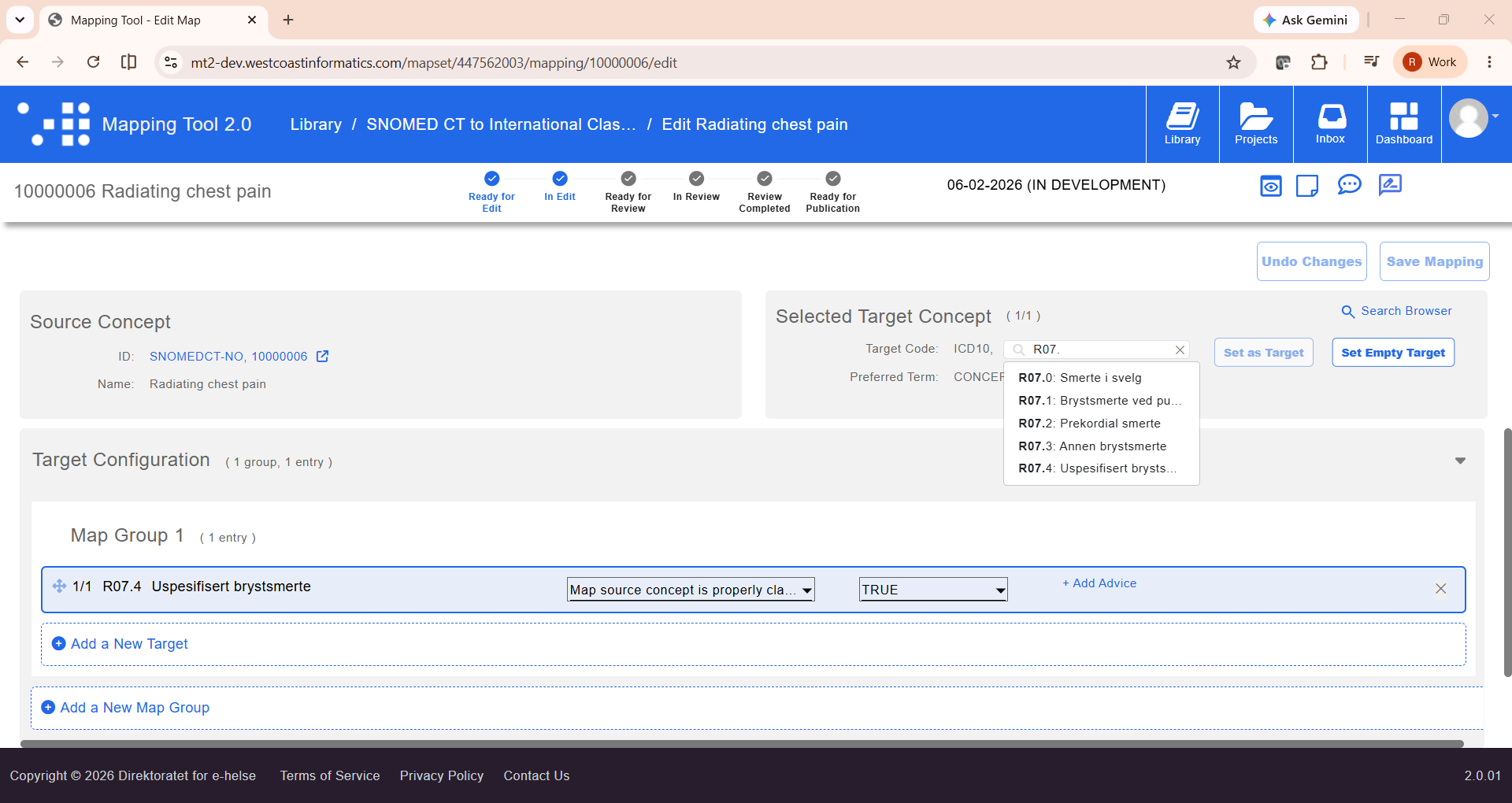
Intelligent Target Suggestions: Manually searching through hundreds of thousands of active concepts consumes significant time and effort. MT2 uses advanced semantic matching to suggest high-probability target concepts, including SNOMED CT, LOINC, and ICD-10-CM, directly alongside local source concepts. This lets subject matter experts focus on validation and decision-making rather than searching, accelerating mapping while maintaining quality and consistency.
Support for Simple and Complex Mapping Relationships: MT2 supports mapping scenarios from straightforward one-to-one relationships to complex one-to-many use cases. For advanced standards-based mappings, it supports structured map representations, including map groups, priority, rules, and advice, to model sophisticated logic such as SNOMED CT to ICD-10-CM. This lets organizations represent real-world clinical, operational, analytics, and reporting requirements faithfully.
Rich Mapping Metadata and Decision Context: MT2 lets mappings be enriched with relationship details, notes, and other contextual metadata, capturing not just what was mapped, but why the decision was made and how the mapping should be interpreted or applied downstream.
Standards-Based and Local Content Mapping: MT2 maps across major healthcare standards, including SNOMED CT, LOINC, ICD-10-CM, and other terminology assets, as well as local, proprietary, and organization-specific content, making it suitable for both standards alignment and internal normalization.
Validation and Review Support MT2 helps subject matter experts and reviewers evaluate individual mapping decisions in a structured environment, supporting quality checks, expert validation, and consistent review before mappings are finalized. This reduces ambiguity and improves confidence in the resulting assets.
Bulk Import and Standards-Based Publication: MT2 supports bulk import of existing source content and legacy mappings, easing migration from spreadsheets and disparate systems. Completed mappings can then be published and exported in standard interoperability formats including FHIR ConceptMap, SNOMED RF2 reference sets, and CSV, for reliable consumption by downstream systems and external partners.
Together, these capabilities give teams the day-to-day tools to map accurately and efficiently, while MT2's enterprise foundation ensures that work scales reliably across projects, stakeholders, and evolving terminologies.
Solving the Enterprise Mapping Crisis
Legacy mapping workflows are notorious bottlenecks. While creating mappings is often viewed as the primary challenge, enterprise organizations struggle more with governance, version control, collaboration, maintenance, and long-term sustainability. MT2 replaces disconnected spreadsheets and siloed processes with an integrated, terminology-server-backed ecosystem that supports the full mapping lifecycle, from initial authoring through ongoing stewardship.
Integrated Terminology Infrastructure: MT2 is fully integrated with the Snowstorm terminology server out of the box, providing direct access to version-aware terminology content, release history, and terminology services throughout the mapping process, so mappings are managed alongside the standards they depend upon, not in isolation. Its flexible architecture also supports other terminology servers, allowing organizations to align with existing infrastructure investments.
Flexible Enterprise Deployment: MT2 can be deployed in a Docker container within an AWS-based ecosystem, giving organizations greater control over security, scalability, infrastructure alignment, and operational management. A programmatic API integrates mapping data and operations into existing systems and automated pipelines, so MT2 supports enterprise mapping programs without forcing organizations into a single deployment model.
Lifecycle Governance and Maintainability: Mappings are not static assets. As source and target terminologies evolve, they must be reviewed, updated, and maintained to preserve accuracy and business value. MT2 provides a structured environment for managing mapping projects, tracking changes, maintaining audit history, and supporting ongoing stewardship. Because mappings are maintained against specific terminology versions, MT2 can flag those affected by inactivated or retired concepts and surface them for remediation, keeping maps accurate as terminologies change.
Configurable Workflow Architecture: No two organizations approach mapping the same way. MT2's configurable workflow architecture lets organizations define their own mapping, review, validation, and approval processes, controlling who participates, what stages a mapping moves through, and what gets enforced at each step. Role-based access controls ensure the right people author, review, and approve mappings at the right stage, maintaining consistency, traceability, and oversight within a controlled, auditable environment, from small expert teams to large multi-stakeholder initiatives.
Program Oversight and Reporting: Beyond individual mappings, MT2 provides reporting and dashboards that surface progress, throughput, and review status across projects, giving program managers the insight to track completion, identify bottlenecks, and manage large-scale initiatives.
Together, these capabilities provide the enterprise foundation for scalable mapping, while MT2's flexible mapping model supports the real-world complexity of clinical data relationships.
Why Clean Maps Matter — and How to Get Started
Whether your organization is migrating legacy EHR clinical notes to standardized fields, deploying analytics across regional health exchanges, or readying datasets for AI ingestion, clean maps are the foundation of trust. True interoperability cannot happen in a silo. MT2 gives organizations the institutional power to confidently translate local metadata into a globally understood medical language. By pairing advanced, real-time mapping technology with rigorous quality assurance milestones, health systems dramatically reduce data loss and clinical ambiguity across the mapping lifecycle.
Ready to modernize your clinical data architecture or scale your enterprise terminology mappings? Here's how to take the next step:
Watch the walkthrough: Catch our full MT2 Walkthrough Video for a guided tour of the platform.
Visit us online: Go to www.westcoastinformatics.com to learn more, or request a demo with our team.
Join us at SNOMED Expo 2026: We'll be presenting MT2 live at the upcoming SNOMED Expo during a dedicated session, available in person and online. If you're attending in Sydney, stop by our booth to see the platform in action and connect with the West Coast Informatics team.