

Automated Terminology Mapping
Terminology Mapping Services
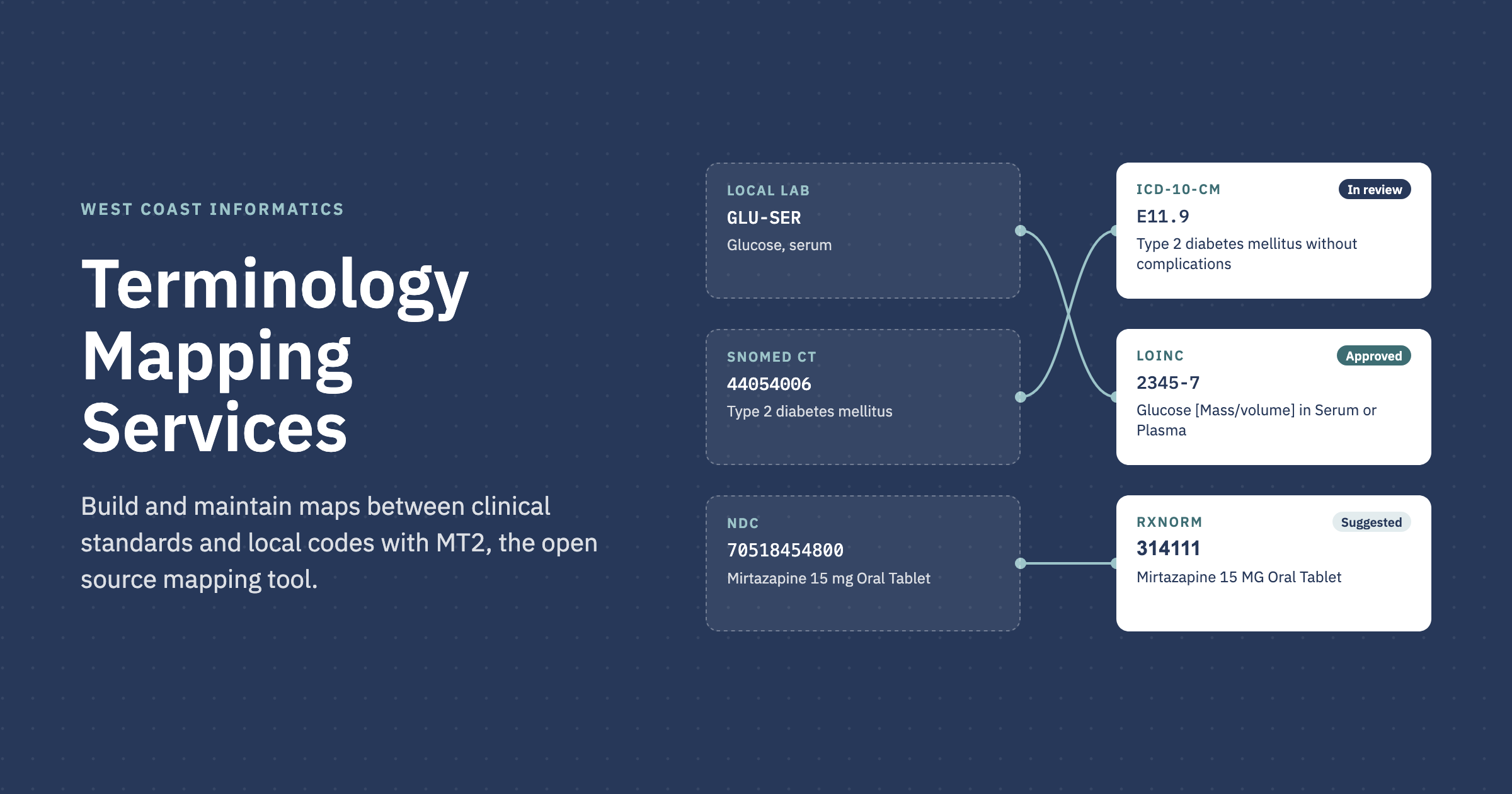
It's built on MT2 (Mapping Tool 2.0), the open source mapping tool we developed with the Norwegian Directorate of Health, where it now runs in production for national mapping. WCI adds ongoing support. Use your own subject matter experts, ours, or both. Every map can start from scratch or from suggested matches. Our flexible workflow model lets you use out-of-the-box workflows or your own approach for review, approval, and governance.
Who is our terminology mapping services for?
Standards organizations and national programs that publish maps others rely on
Teams maintaining cross-terminology maps through new source and target releases
Hospitals, labs, and payers with local codes that need to match national standards
Organizations that need mapping capacity or expertise they don't have today
What are MT2’s capabilities?
MT2 is built for production mapping at scale. The capabilities that matter most for productivity and control are:
Suggested mappings. Suggestions can be in place before mappers open the first record. MT2 works with the suggestion service of your choice, such as AutomapAI™, so mappers review, validate, and refine instead of searching each record from scratch. Projects can also start without suggestions.
Bulk actions. Apply mapping rules across large sets of source codes at once, approve in batches, and edit thousands of records when standards or guidance change.
Language support. Source terms and their localized variants appear side by side, in whatever languages a project uses. A Norwegian project, for example, shows English alongside Bokmål and Nynorsk. Two terms that look nearly identical in English can be clearly different in Norwegian, so seeing both helps mappers choose the right one.
Terminology server integration. Connects to a live terminology server such as TermHub™ o or SNOMED International's Snowstorm, so teams always work against current source and target versions. Mapping changes are made directly in the server, so they are available immediately and validated against live content.
Secure deployment. Runs as a container in your environment, behind your own network and access controls, or hosted by WCI. It connects to your existing authorization system and logs every change for audit.
Also included
Flexible workflow. Role based review stages that match your approval process.
Bi-directional mapping. Any standard or local code system as source or target, in either direction.
Complex maps. Multi-group maps, priority order, conditional rules, and structured advice, as maps like SNOMED CT to ICD-11 require.
Views for every level. A record view that guides newer mappers, and a high density table view for experienced mappers working through large sets.
How our terminology mapping service works
MT2 is open source and available now, so you can run it on your own. If you want support for the tool, WCI provides it under a simple SLA. If you want help with the mapping itself, our team can take on some or all of the work, including initial mapping, review, and preparing maps for release. Whichever you choose, you retain full governance of your maps, including final approval of each release.
From standard to standard maps
Maps between standards let data recorded in one standard be used in another, for billing, reporting, research, and data exchange. Common examples include SNOMED CT to ICD-10, ICD-10 to ICD-11, and national editions to international releases.
Building and publishing a map
Most maps are direct code-to-code matches. The challenge is making thousands of them accurately and consistently, then validating, checking, reviewing, and releasing the full map without errors slipping through.
MT2 supports every stage of mapping in one place: authoring, validation against current terminology content, quality checks across the full map, and review. Each mapping moves through your approval stages with a record of who changed or reviewed what. Nothing is released until you approve it, and the finished map is yours to govern.
Maintaining maps you already have
A published map is never finished. Every release of the source or the target retires concepts, inactivates others, and quietly breaks mappings that were correct last quarter. Finding them by hand does not scale, and missing them is how a published map loses trust.
MT2 checks your map against each new release, flags the mappings affected by retired or changed concepts, and supports fixing them in bulk. Corrections move through your review process, and every change is logged for audit.
From local codes to standards maps
Standards are only half the picture. Most healthcare data starts as local codes: in-house lab tests, pharmacy items, procedures, and diagnoses built up over years. Those codes work inside one system but not outside it. Each one needs to be matched to the right standard, such as LOINC, SNOMED CT, RxNorm, or ICD-10-CM, reviewed, and kept current as new codes are added.
In MT2, your local codes are mapped to the standards you need, and every match is reviewed before it's final. The map stays current as new local codes are added and the standards update, so your data stays clean and consistent.
Faster mapping with AutomapAI
AutomapAI is an optional add-on from WCI that provides suggested matches for MT2. The slowest part of mapping is the initial search for the right target. A mapper may review dozens of candidates across hundreds of thousands of concepts before settling on one match. Even when the right match is obvious, selecting it record after record becomes time consuming. AutomapAI takes on most of that work. It reads each source term, finds the most likely matches, rates its confidence in each, and loads them into MT2 ready for review. When no match is confident enough, the term is left open for the mapper rather than filled with a guess.
That changes where your experts’ time goes. Mappers confirm straightforward matches quickly and focus their effort on the cases that need judgment. Projects start sooner and finish with fewer expert hours, without lowering the bar for review.
MT2 is built for three situations:
Starting a new mapping project with suggested matches already in place
Updating maps for new releases by suggesting replacements for retired or changed concepts
Providing suggestions for local codes to standards at volume, so experts focus on the hard cases
How we work with you
Choose the level of support that fits your team. Options can be combined.
Tooling support. An annual SLA covering MT2 support and hosting, across one or more mapping projects.
Mapping support. Our mappers take on some or all of the mapping, or provide subject matter experts for difficult maps.
Open source. Run MT2 on your own. New features are released to the public repository as we build them, so teams that keep their deployment current get them as they ship.
Get started
Talk to us about
For over 15 years, our team has authored and maintained maps and code systems for national programs and standards organizations, including the initial SNOMED CT to ICD-11 map for SNOMED International. Tell us what you're mapping and what you need, and we'll give you a straightforward answer on whether we're the right fit for you
MT2 Resources:
Video: MT2 walkthrough video
GitHub: Back End Repository
GitHub: Front End Repository
Blog: MT2 Product Announcement
Blog: Solving Terminology Drift with MT2 - Standard to Standard, Release After Release
Blog: How to Map Local Codes to Standard Terminologies Using MT2
Presentation: Join on Thursday, 22 October at the 2026 SNOMED Expo in Sydney, Australia